Projects are where people who want to buy land or buildings together find each other, agree what they are building, form the vehicle, raise the money and then buy, bound with a deposit and conveyed on the Homebinding record like any other sale.
The idea
A million people want to live another way. The kibbutz did it, Auroville does it, and British communities from Findhorn to Stroud do it now. Here is where the next one forms.
Most of the land and buildings that could hold a community come to market one at a time, priced for a single buyer, and are gone before a group can form. A project turns that round. Someone names a place and a purpose; people join, say what they can put in and what they can do; the group chooses its legal form, agrees its rules and raises the funds; and when it is ready it makes an offer on the record and the sale runs to completion like every other Homebinding sale, with the searches, the legal pack, the solicitor's check and the register at the end of it.
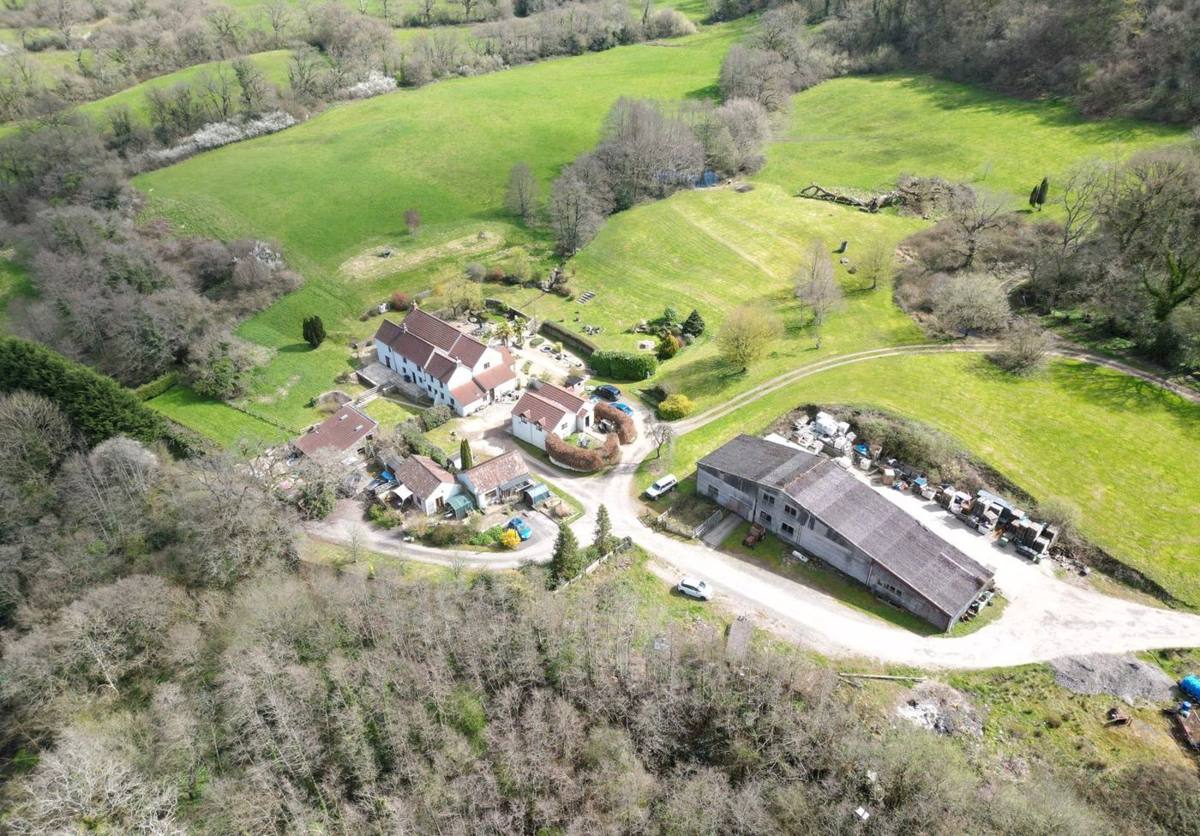
Homebinding provides the place to gather, the tools to organise, the law read in full on the site, and the sale itself. What the community becomes is the members' own. The first project is the founder's: Whitehole Springs Farm, below.
A closed church for a village workshop, a farm for a co-housing group, a plot for a self build collective, a mill for makers. Name the place and the purpose and open it to members.
A project starts with a property, or a kind of property and an area, and a plain statement of what the community will do there. The founder sets the first draft of the values, the size of the group, and the outline of how money and decisions will work.
2
GatherMembers
People join the project on the site, say where they are, what they can contribute in money, skills and time, and whether they would live there, work there or support from outside. The discussion runs on the project page, in working groups: land, buildings, money, legal, governance, education, growing, making.
3
Choose the vehicleMembers, with a solicitor
A group cannot hold registered land in its own name; a vehicle holds it. The choices are set out below, each with the Act that creates it. The founding members adopt the rules or articles, register the body, and open its bank account. From here the vehicle is the buyer.
4
Raise the moneyMembers and lenders
Member capital, community shares where the vehicle is a society, loans from members, ethical and community lenders, grants, and a mortgage on the land where the plan allows one. The money page explains what each lender will and will not do, and which borrowing is regulated. Pledges are recorded against the project and become subscriptions when the vehicle is formed.
5
Plan the useMembers, with the planning pages
What the land may be used for is a planning question before it is anything else. Agricultural land, Class Q conversions, rural exception sites, the National Planning Policy Framework on isolated homes, listed buildings, SSSI land: the planning library on Homebinding holds every Act and the policy, read in full, so the group knows before it bids what it can lawfully do.
6
Make the offer and bind the saleThe vehicle, on the record
The vehicle makes the offer on the Homebinding record. On acceptance the memorandum is generated, the reservation agreement is signed and the deposit paid, the searches are ordered that day, the legal pack is assembled and checked by the vehicle's solicitor, and contracts are exchanged. How the sale works.
7
Complete, register, beginEveryone
Completion, registration of the vehicle as proprietor, and the first day. The project page stays open as the community's own noticeboard and record.
The vehicle
Five ways a group can own land together, and the Act behind each
Vehicle
What it is
Suits
The law
Community benefit society
A society registered with the Financial Conduct Authority that must run for the benefit of the community, not only its members, one member one vote, with an asset lock available. It can raise money by community shares from the public without a prospectus, within limits.
A community that wants many small investors, an asset lock and open membership
A body, usually a society or a company limited by guarantee, that meets the statutory definition: it holds land for the benefit of a defined community, its profits go to that community, and local people control it.
Keeping homes and land affordable for a place in perpetuity
A company with members rather than shareholders, no share capital, and articles that can lock its assets to its purpose. Registered at Companies House. It can also be a registered charity if its purposes are charitable.
Education, arts and community enterprises; a body that will apply for grants
In Scotland the community right to buy under the Land Reform (Scotland) Act 2003 and the Land Reform (Scotland) Act 2016 gives a community body a statutory route to land. In England a community can nominate a building as an asset of community value under the Localism Act 2011, which gives it six months to bid when the owner decides to sell. Self build and custom build groups register with their council under the Self-build and Custom Housebuilding Act 2015. A solicitor advises the group on the choice; Homebinding sets out the options and holds the record.
The models
How the world has done it: the kibbutz, Auroville, and the British communities that exist today
A community is a legal structure, a way of paying its way, a planning permission and a way of deciding things, before it is anything else. Each of these did all four differently. Every figure below carries its source; the numbered links open it.
Photograph: Moshe Pridan, Public domain
The kibbutz (Israel)
The first kibbutz, Degania, was founded in 1910 1. Early kibbutzim ran on complete communal ownership: members held no individual property, and gifts and income received from outside were turned over to the common treasury 2. The land itself was bought by the wider Jewish community through the Jewish National Fund rather than by the settlers 3. The movement went through a severe economic crisis in the 1980s, after which many people left 4. By 2012, 188 kibbutzim (72 percent) had converted to the more individualistic "renewing kibbutz" model, with differential pay and private budgets 5. Degania itself voted for privatisation in 2007 6. In 2010 there were 270 kibbutzim with a total population of 126,000 7. What still holds: the land remains primarily state or JNF owned, and most kibbutzim keep a legal requirement of mutual guarantee among members 8.
Photograph: Mohan Babu V, CC BY-SA 4.0
Auroville (Tamil Nadu, India)
Auroville's Charter was broadcast at its inauguration on 28 February 1968 by All India Radio in 16 languages 1. The Charter's first clause reads: "Auroville belongs to nobody in particular. Auroville belongs to humanity as a whole. But, to live in Auroville, one must be a willing servitor of the Divine Consciousness." 2. The Auroville Foundation Act 1988 received presidential assent on 29 September 1988; the Foundation was set up in January 1991 and all Auroville assets were formally vested in it on 1 April 1992 3. The Act creates three authorities: a Governing Board nominated by the Indian central government, a Residents' Assembly of all registered residents aged 18 and over, and an International Advisory Council 4. There is no private ownership of land, housing or business in Auroville 5. In 2024 the population was 3,300 Aurovilians, down from 3,368 in 2023, with Indians making up 51.5 percent (1,700 people) and crossing 50 percent for the first time 6. Joining runs in three stages: at least three months as a volunteer, then a 12 month Newcomer trial period during which you must secure your own housing and full time work in an Auroville unit, then application to the Register of Residents; the process follows the Auroville Foundation (Admission and Termination of Persons) Regulations 2023 7. Applicants are told to plan to cover their own living costs during both periods 8. The economy is funded by profits of commercial units inside Auroville, Auroville International centres abroad, guest houses, donations and Indian government funding for education and infrastructure; residents receive a monthly "maintenance" from their workplace that is usually just enough to meet basic needs 9.
Photograph: Findhorn Foundation, CC BY-SA 4.0
Findhorn (Moray, Scotland)
Peter and Eileen Caddy and Dorothy Maclean started the community in a caravan park in 1962 with six people 1. It was registered as a Scottish charity, the Findhorn Foundation, in 1972; the Foundation bought Cluny Hill Hotel in 1975 and the caravan park (now the Park Ecovillage) in 1983 2. The ecovillage was named a UN Habitat Best Practice in 1998 and 2018 3. A 2006 study found residents had an ecological footprint of 2.71 hectares per person, a little over half the UK average of 5.4 4. The Park has four Vestas wind turbines with up to 750 kW capacity, and a Living Machine sewage treatment system opened in 1995 5. In July 2023 the Foundation said it was no longer financially viable and would end its educational programmes by 22 September 2023, with around 50 of 60 staff at risk of redundancy 6. A community benefit society, Ecovillage Findhorn CBS, was founded in May 2023 to move land and infrastructure into community ownership, and the first major stages of the land purchase completed on 18 November 2024, backed by over £415,000 of community-raised investment 7.
Photograph: Paul Dobraszczyk, CC0
Lammas ecovillage and One Planet Development (Wales)
Lammas is nine smallholdings on a hillside in Pembrokeshire, won on appeal to the Welsh Assembly in 2009 after two refusals and one lapsed application 1. It was permitted under Pembrokeshire's low impact Policy 52, which required residents to meet 75 percent of basic needs from the land; the Welsh Government then replaced Policy 52 with a Wales-wide policy, One Planet Development 2. One Planet Development sits in Technical Advice Note 6 (July 2010) and allows new homes in open countryside where applicants show a land-based livelihood: households must reach an ecological footprint as low as 2.4 global hectares per person after five years, meet basic household needs from land-based livelihoods within five years, and build zero carbon in construction and use 3. The 65 percent food test in the Practice Guidance works like this: you must produce at least 30 percent by value of your own food on the land, and cover a further 35 percent either by more production or by income from land-based activity; if you produce 65 percent or more of your food on site, no land-based income is required 4. At least three acres is normally needed per household, with typical developments nearer five to ten acres 5. If the targets are not met after five years without a clear plan to fix it, the exit strategy in the management plan is invoked and the houses are removed; the permission stays permanently conditional on meeting the OPD requirements 6.
Photograph: Nigel Mykura, CC BY-SA 2.0
Tinkers Bubble (Somerset)
Tinkers Bubble is an off-grid woodland community founded in 1994 on about 28 acres of Douglas fir, larch and broadleaf woodland, working the land without fossil fuels using horses, hand tools, solar power and wood 1. The land was being transferred to the freehold ownership of a co-operative, Tinker's Bubble Land Ltd, under a management plan tied to a section 106 agreement 2. Planning permission for the self-built houses is conditional on residents making a living from the land 3. After roughly 25 years of temporary permissions (a further ten-year temporary permission was granted on 9 April 2016), South Somerset District Council granted permanent permission on 18 April 2023 4. The community is currently seven adults plus long-term volunteers and is open to new members 5.
Photograph: Richard Croft, CC BY-SA 2.0
Hockerton Housing Project (Nottinghamshire)
Five earth-sheltered homes near Newark, completed in September 1998 and designed by Brenda and Robert Vale 1. The houses have no whole-house heating system, and residents generate their own electricity and harvest and treat their own water 2. Rainwater supplies about 250 days of non-potable water a year, conservatory roofs supply drinking water, and sewage goes through a reed bed 3. Residents own their homes but are also members of a co-operative, and commit to 300 unpaid maintenance hours and 300 paid hours a year for the co-operative's business 4. The trading arm is Hockerton Housing Project Trading Ltd, a not-for-profit co-operative 5.
Photograph: Stephen Craven, CC BY-SA 2.0
LILAC, Leeds (mutual home ownership)
LILAC (Low Impact Living Affordable Community) is 20 eco-build households in Bramley, west Leeds 1, opened to residents in 2013 as the first Mutual Home Ownership Society in the UK 2. Residents pay around 35 percent of net income each month to the society; these payments buy equity shares and, after maintenance and insurance, service a single collective mortgage 3. That mortgage is a 25 year fixed rate loan from Triodos at 3.5 percent above base rate, and equity shares equal 90 to 110 percent of each home's cost 4. Equity is linked to national earnings rather than house prices, and members sell their shares back if they leave 5; anyone leaving within three years forfeits any rise in value 6.
Photograph: Springhill Cohousing
Springhill Cohousing, Stroud
Springhill describes itself as the first new-build cohousing scheme completed in the UK 1. Planning permission came in June 2001, building started in August 2002 and the first residents moved in during summer and autumn 2003 2. There are 35 houses and flats, a three-storey common house, and the site is owned by The Cohousing Company Ltd, a company limited by guarantee, with residents as members and directors 3. Decisions are made by consensus at monthly residents' meetings, with mandated committees (kitchen, garden, parking, disputes) to keep whole-group meetings short 4.
Photograph: Peter McDermott, CC BY-SA 2.0
Lancaster Cohousing (Forgebank, Halton)
Forgebank has 41 homes plus a common house, ranging from one to three bedrooms, built to the Passivhaus standard and Code for Sustainable Homes level six 1. Lancaster Cohousing is a not-for-profit company registered in April 2006; monthly general meetings decide by consensus 2. The first residents moved in in 2013, the homes are leasehold, and the site sits next to Halton Mill, a 1,000 square metre workspace co-operative, with the 160 kW Halton Lune Hydro upstream on the River Lune 3.
Photograph: John Yaxley, CC BY-SA 2.0
Marsh Farm Outreach (Luton)
Marsh Farm Outreach grew out of the Exodus Collective, a housing co-operative founded in 1992 that renovated derelict properties on the Marsh Farm estate 1. It is a workers' co-operative that has operated on the estate since 2005 2. The estate won £48 million of New Deal for Communities regeneration money between 1999 and 2009 3. MFO ran the first Organisation Workshop in the UK, a Brazilian model of large-group self-organised enterprise building, and runs Marsh House, a seventeenth-century farmhouse that houses eight enterprises 4. It is relevant here as a model of a community organising to take control of buildings and land on an existing estate, rather than buying rural land.
Photograph: Grec man, CC BY-SA 4.0
Bruderhof communities in the UK
The Bruderhof was founded in 1920 by Eberhard Arnold in Sannerz, Germany 1. Members hold no private property and pool everything, and business income is used for the community's care and outreach 2. In the UK there are three communities: Darvell at Robertsbridge, East Sussex (1971), Beech Grove at Nonington, Kent (1995), and a house in Peckham, south London (2005) 3. Beech Grove has around 240 members (150 adults and 90 children); members receive no wages, and membership is a voluntary lifetime commitment 4. The main business is Community Playthings, which makes wooden classroom furniture and toys 5. Worldwide there were 24 communities and about 3,000 members in 2024 6.
Photograph: Pudelek, CC BY-SA 4.0
Christiania (Copenhagen), briefly
Christiania was founded on 26 September 1971 when squatters occupied a former army barracks in Christianshavn; it covers 7.7 hectares with roughly 850 to 1,000 residents 1. After decades of dispute, residents set up a foundation (Fonden Fristaden Christiania) to buy the site from the state, and made the first payment in July 2012, becoming legal landowners 2. Decisions go through a residents' plenum and working groups 3. In April 2024 residents and police shut down and physically dug up Pusher Street after gang violence 4.
Photograph: Rashaun, CC0
Twin Oaks (Virginia, USA), briefly
Twin Oaks was founded in 1967 on a former tobacco farm, inspired by B. F. Skinner's Walden Two, though behaviourist ideas were dropped for egalitarian ones 1. About 100 adults live on 465 acres, sharing income under a labour credit system of roughly 36 hours a week that counts domestic and income work equally; housing, food and healthcare are provided free 2. Businesses (tofu, hammocks, book indexing, seed packing) bring in about $600,000 a year, and the community is a member of the Federation of Egalitarian Communities 3.
Photograph: Simon du Vinage, CC BY 2.0
Tamera (Portugal), briefly
Tamera was founded in 1995 on 335 acres in the Alentejo, with origins in a German group formed in 1978 1. About 250 residents and students live there; it calls itself a "healing biotope" and peace research centre 2. With Sepp Holzer it built a water retention landscape of lakes and wetlands in the dry Alentejo, and it has run an experimental solar village designed to serve 50 people 3.
The full spectrum
How peoples around the world have always held land, homes and work in common
The kibbutz and Auroville are twentieth century experiments. Shared land, shared work and decisions taken together are far older and belong to no one country or politics. Fourteen traditions, each from its own people, each figure with its source.
Photograph: Jaro Nemčok, CC BY-SA 3.0
Haudenosaunee longhouse and clan mothers (Iroquois, northeastern North America)
Haudenosaunee longhouses were sometimes more than 75 m (246 ft) long but generally 5 to 7 m (16 to 23 ft) wide, with a typical house averaging about 24.4 by 5.5 by 5.5 m (80 by 18 by 18 ft) 1. A longhouse was designed to house up to twenty or more families, most of whom were matrilineally related 1. Property and inheritance passed through the maternal line, and children were born into the mother's clan 1. Fireplaces ran down the centre, with smoke holes above the hearths and doors at both ends 1. Villages were moved roughly every five to twenty years as soil and firewood were depleted 2. Farming was women's work, from planting to cooking, and the crops were corn, beans and squash, called the three sisters 2. A typical clan had about 50 to 200 people 2. Under the Great Law of Peace the League is governed by a Grand Council of fifty chiefs or sachems, each representing a clan of a nation, and the sachems were chosen by the clan mothers 2. In 2010 more than 45,000 enrolled Six Nations people lived in Canada and over 81,000 in the United States 2.
Photograph: Tom Ackroyd, CC0
Māori marae and papakāinga (Aotearoa New Zealand)
A marae is a place where Māori culture can be celebrated, the Māori language spoken and intertribal obligations met 1. Its main buildings are the wharenui, a meeting house used for meetings, sleepovers and cultural activities, and the wharekai, a dining hall used primarily for communal meals 1. Marae are registered as reserves under the Te Ture Whenua Māori Act 1993, with an iwi (tribe), hapū (sub-tribe) or whānau (family) as beneficiaries, and each marae has a group of trustees responsible for its operations 1. Each marae negotiates a charter covering its beneficiaries, how trustees are selected, accountability and committee procedures 1. A tangihanga (farewell for the dead) takes precedence over any other gathering 1. Most iwi, hapū and many small settlements have their own marae, and urban intertribal marae have developed since the mid-20th century 1. The traditional kāinga village was generally occupied by one hapū, which identified itself with the nearest mountain and river 2. The Te Ture Whenua Māori Act 1993 aims to retain land in the hands of its owners, their whānau and hapū, and promotes groups of buildings that allow Māori to live sustainably on their land, known as papakāinga 3.
Photograph: Richard Mortel from Riyadh, Saudi Arabia, CC BY 2.0
A siida is a traditional Sámi organisation of several families of reindeer herders whose reindeer graze together 1. Its legal forms today are the sameby in Sweden, the reinbeitedistrikt in Norway and the paliskunta in Finland, while in Russia the kolkhoz replaced the traditional organisations 1. In 2013 Sweden had 51 sameby, of which 8 were concession sameby and 9 were forest sameby 1. In Sweden and Norway membership is limited to people of Sámi descent on the basis of ancestral pastoralist rights, and Sweden's 1928 rules barring settled Sámi were removed by the 1971 Reindeer Herding Act 1. Finland has 56 paliskuntas, of which 13 in the far north of Lapland form the Sámi area, and membership there is not restricted to ethnic Sámi 1. In Finland the districts operate like stock companies: reindeer holders elect a board and a reindeer master every three years, voting with as many votes as they have reindeer 1. Norway's 2007 Reindeer Husbandry Act recognised the traditional siida units and centred grazing on sustainable resource use based on local culture and tradition 1.
Photograph: Tobias Deml, CC BY-SA 4.0
Andean ayllu, ayni and minka (Peru, Bolivia, Ecuador)
The ayllu is the traditional form of community in the Andes, especially among Quechuas and Aymaras, and a model of indigenous local government in Bolivia and Peru 1. It is a network of families in a given area, often with a putative common ancestor 1. Each ayllu owned a parcel of land, and members had reciprocal obligations to each other 1. Labour took three forms: mit'a, a labour tax levied by Inca and Spanish governments; ayni, reciprocal work exchanges among members; and mink'a, communal labour for common purposes 1. The male head is the mallku, and in Bolivia ayllus send delegates to a national council, Conamaq 1. Ayllus existed before the Inca conquest and continue to the present day 1. In ayni, members help others with tasks such as construction and planting, the host provides food and drink, and those helped later return the favour 2. Among the Q'ero ayni is regarded as the most important principle 2. Mink'a is voluntary collective labour for community infrastructure such as irrigation canals, usually without salary, a cash-free form of local taxation 3. It is practised in Colombia, Peru, Ecuador, Bolivia, Chile and Paraguay to this day 3.
Photograph: Erasmus Kamugisha, CC BY-SA 4.0
Maasai homestead and age sets (Kenya and Tanzania)
The Maasai are an Eastern Nilotic people native to northern, central and southern Kenya and northern Tanzania, near the African Great Lakes 1. Maasai in Tanganyika were displaced from lands between Mount Meru and Kilimanjaro in the 1940s, and more land was taken for parks including Amboseli, Maasai Mara and Tsavo in Kenya and Ngorongoro and Serengeti in Tanzania 1. Traditional life centres on cattle, a man's wealth is measured in cattle, wives and children, and a herd of 50 cattle is respectable 1. The traditional diet was raw meat, raw milk, honey and raw blood from cattle, though more than 58% of the modern diet is plant food, especially ugali 1. Boys are initiated through circumcision and become warriors, and graduation from warrior to junior elder takes place at a large gathering known as Eunoto 1. The laibon is the central religious figure, with roles in healing, divination and prophecy 1. The Maasai are pastoralists who have resisted government urging to settle, though many have moved into commerce and government 1. Kenya counted 1,189,522 Maasai in 2019 against 377,089 in 1989, and Tanzania had about 1,000,000 in 2024 1.
Photograph: John Fyfe, CC BY-SA 4.0
Taos Pueblo (New Mexico, United States)
Taos Pueblo is an adobe settlement of the Pueblo people established in the late 13th and early 14th centuries 1. It was designated a UNESCO World Heritage Site in 1992 1. The north side pueblo has adobe walls often several feet thick, and the structures were historically stacked five or six storeys high 1. Homes typically consist of two rooms, one for living and sleeping and the second for cooking, eating and storage 1. Within the old pueblo electricity, running water and indoor plumbing are prohibited 1. As of 2010 about 150 people lived in the historical pueblo full time, and as of 2012 about 4,500 people lived on the tribal lands of 95,000 acres (38,000 ha) 1. President Theodore Roosevelt took 48,000 acres including Blue Lake, returned in 1970 under President Nixon, and a further 764 acres (309 ha) were transferred in 1996 1. The community is led by a cacique with spiritual and political responsibilities, a Tribal Council of former governors acts as advisors, and a governor is chosen each year for outside matters 1. The pueblo closes the village to any non-Indian on All Souls' Day 1.
Photograph: Unknown - "from E. K. Leslie Collection"., CC0
Aboriginal homelands and outstations (Australia)
Outstations, or homelands, are small decentralised communities of close kin formed by Aboriginal people moving to land of traditional and cultural significance 1. The movement of the 1970s and 1980s reclaimed autonomy and self-sufficiency after assimilation policies failed, alongside moves towards self-determination and land rights 1. Most outstations sit on Aboriginal-owned land covering about 500,000 km2 1. Most are small family groups, a few exceed 100 residents, and people move often between outstations and larger centres 1. In 1997 about 12,000 people lived at roughly 1,000 outstations; in 2013 some 10,000 lived on 520 Northern Territory homelands, 25% of its remote Indigenous population; in 2018 there were about 1,200 outstations nationally; and around 2020 about 500 homelands had 2,400 residences housing roughly 10,000 people 1. ATSIC was abolished in 2005, the 2007 Northern Territory Emergency Response shifted responsibility to the Territory, and the 2009 Working Future policy focused on 20 Territory Growth Towns and required homelands to show increasing self-sufficiency 1. Reported benefits include better health and wellbeing, maintenance of culture and connection to country 1. Underfunding persists, and by 2021 some housing was so derelict and overcrowded that residents lived in tents 1.
The Inuit number about 155,066 people: 70,540 in Canada, 50,878 in Greenland, 17,067 in Denmark and 16,581 in the United States 1. In 2021 Nunavut had 30,865 Inuit and Quebec 15,800 1. The traditional economy was hunting and fishing for whales, seals, polar bears, muskoxen, caribou, birds and fish 1. Goods were shared within a household and also, to a significant extent, within a whole community 1. In winter some Inuit lived in snow igloos, in the months above freezing in skin tents called tupiq, and some groups built sod houses 1. Every household had its head, either an elder or a particularly respected man, and conduct followed customary rules: maligait, what has to be followed; piqujait, what has to be done; and tirigusuusiit, what has to be avoided 1. The Inuvialuit received Northern Canada's first comprehensive land claims settlement in 1984, Quebec Inuit settled in 1975, Labrador Inuit in 2005, and the Nunavut Land Claims Agreement of 1993 enabled the creation of Nunavut in 1999 1. Subsistence hunting continues today, and Inuit carving, print making, textiles and throat singing are popular in Canada and globally 1.
Photograph: Talana, CC BY-SA 3.0
Ubuntu and the Zulu homestead (southern Africa)
Ubuntu is a term from the Nguni Bantu languages of southern Africa meaning humanity, often translated as I am because we are, and expressed in the maxim a person is a person through people 1. Nelson Mandela recalled that a traveller did not have to ask for food or water because the people gave food and attended to him 1. South Africa's 1993 Interim Constitution called for ubuntu rather than victimisation, and ubuntu is seen as a formative influence on the Truth and Reconciliation Commission 1. The Zulu kraal is a circular arrangement of beehive-shaped huts around a central cattle enclosure, with an outer wooden fence around the whole and an inner one for the cattle 2. The hut opposite the entrance belonged to the chief or his mother, his wives' huts were nearest his, sons' huts stood on the left, daughters' on the right and guests' by the entrance 2. Ancestor rituals were carried out by the headman, an important ceremonial position 2. A Nguni homestead is a cluster of houses occupied by a single extended family, and in 2022 4.3% of South African households were classed as traditional dwellings 3.
Photograph: Ron Shawley on Panoramio, CC BY 3.0
Amish mutual aid and barn raising (United States and Canada)
The Old Order Amish numbered 421,340 in 2026, about 414,545 in the United States and over 6,000 in Canada, and the population doubles roughly every 20 years 1. The largest state populations were Pennsylvania (96,535), Ohio (87,760) and Indiana (68,025) 1. Amish families own their farms 1. Church districts have 20 to 40 families, each led by a bishop with ministers and deacons chosen by election and lot 1. The Ordnung, the community's rules, is reviewed twice a year by all church members 1. In Holmes County full-time farming fell from about 75% of married men in 1965 to 16% in 2015 1. The Amish generally do not carry commercial health insurance, and in some communities the church collects money to pay members' medical bills 1. Since 1965 self-employed Amish have been exempt from Social Security taxes by law 1. In a barn raising the community builds a member's barn collectively, all able-bodied members are expected to attend, and each can ask for help on the presumption of reciprocation 2. Men build, women provide food, and the work takes one to two days 2. The tradition continues largely unchanged in some Amish and Old Order Mennonite communities 2.
Photograph: awmcphee, CC BY 4.0
Hutterite colonies (Canada and United States)
As of 2024 there were 58,392 Hutterites in 544 colonies, 391 in Canada and 153 in the United States 1. Hutterites practise a near-total community of goods: all property is owned by the colony, and provisions for members and their families come from common resources 1. There are no paychecks; members work for the good of the community and receive small allowances 1. Housing units are assigned to families but belong to the colony, and there is very little personal property 1. Lunch and dinner are eaten communally in the colony dining room 1. A colony typically has 10 to 20 families and 60 to 250 people, and when it nears the upper limit the leadership decides to branch off, at a cost of around C$20 million in 2008 terms 1. Each colony is led by a minister, a secretary who acts as business manager and an assistant minister, with decisions made by a council, usually seven senior males, and the voting membership of all married men 1. Women have no formal vote 1. Work is assigned through roles such as farm boss and hog boss, and colonies run industrial hog, dairy and poultry operations and increasingly manufacturing 1.
Photograph: Zarateman, CC0
Mondragon Corporation (Basque Country, Spain)
Mondragon was founded on 14 April 1956 by the priest José María Arizmendiarrieta and his students in Mondragón in the Basque Country, and its first product was paraffin heaters 1. In 2024 it had revenue of 11.213 billion euros and 70,085 workers, of whom 30,660 were in the Basque Country, 29,340 in the rest of Spain and about 10,000 abroad 1. It operates on ten cooperative principles including open admission, democratic organisation and the sovereignty of labour, with group decisions taken through the Cooperative Congress 1. Agreed wage ratios between executive and factory work range from 3:1 to 9:1 across cooperatives and average 5:1; in 1991 manager pay was 30% below comparable local firms while the lowest wages were 13% higher 1. The group includes the retailer Eroski, with 6.6 billion euros turnover and 2,069 stores in 2013, the bank Laboral Kutxa and Mondragon University 1. On 16 October 2013 the appliance maker Fagor Electrodomésticos, with 5,600 employees, filed for bankruptcy, and in July 2014 it was bought by Cata for 42.5 million euros 1. In 2022 ULMA Group and Orona voted to leave, cutting the workforce by 13% and group sales by 15% 1.
Photograph: Anggabuana, CC BY-SA 4.0
Balinese subak (Bali, Indonesia)
Subak is the water management and irrigation system for the paddy fields of Bali, forming a pulsed artificial ecosystem that is at once autonomous and interdependent 1. It was developed in the 9th century, and the first known written record dates from around the 11th century 1. Water temples are central to its management, the supreme temple being Pura Ulun Danu Batur on Lake Batur, and the system embodies the Tri Hita Karana philosophy of relationship between humans, the earth and the gods 1. Members of a subak meet in assemblies called paruman krama subak to make decisions 1. A small subak is led by a pekaseh (chairman), while larger ones have a prajuru management body with a vice-chairman, secretary, treasurer and water distributor 1. As of 2019 there were an estimated 1,559 subaks 1. In 2012 the system was inscribed as a UNESCO World Heritage Site, the Cultural Landscape of Bali Province, covering 19,519.3 hectares (48,233 acres) 1. Threats include farmland conversion of about 1,000 hectares a year across Bali, diversion of water to tourism, which uses 65% of Bali's freshwater, and farmer ageing, with an average age over 40 in 2019 1.
Photograph: Seth Vidal, CC BY-SA 2.0
Satoyama (Japan)
Satoyama is the Japanese term for the border zone between mountain foothills and arable flat land, combining sato (village) and yama (mountain) 1. The landscape is a mosaic of mixed forests, rice paddies, dry fields, grasslands, streams, ponds and irrigation reservoirs 1. Farmers used the grasslands for livestock and kept deciduous oak forests open by regular coppicing to stop succession to dense laurel forest 1. In the Edo era villagers gathered leaves for fertiliser and cut wood for construction, cooking and heating 1. Shared ownership of satoyama forests near villages has been common since the beginning of the 19th century 1. The landscape began disappearing after the 1960s because of migration to cities between 1955 and 1975, the shift from charcoal and firewood to oil, chemical fertiliser replacing compost, and pine wilt disease in the 1970s 1. A satoyama conservation movement grew in Japan through the 1980s and 1990s, and the Satoyama Initiative was established at UNESCO in 2009 to promote such landscapes globally for biodiversity 1. No English Wikipedia page for iriai could be found, so the iriai commons are not covered here.
See it: the kibbutz and Auroville on film
Eight films, the people who live it in their own words. The comments beneath the kibbutz films are as useful as the films.
The Kibbutz: Israel's Collective Utopia | History of Israel Explained | UnpackedUnpacked · 144k viewsAuroville, The City The Earth NeedsOlivier Barot · 78k viewsHow Do Kibbutzim Work? The Socialist Communes That Shaped IsraelVisualPolitik EN · 36k viewsWhat Life Is Like On An Israeli Kibbutz | Zionism Revisited | UnpackedUnpacked · 287k viewsWhat Is A Kibbutz? - Apr. 19, 2018ILTV Israel News · 302k viewsIsrael: Welcome to Kibbutz Sasa, which lives as it did at time of country's foundingFRANCE 24 English · 21k viewsKibbutz Nof GinosarGene and Ruth Gleba · 3k views
The structures, in detail
Who holds the land, and who regulates them
**Community Land Trust (CLT).** A CLT is defined in section 79 of the Housing and Regeneration Act 2008 by two tests: it must be set up to further the social, economic or environmental interests of a local community by acquiring and managing land and assets, and profits must benefit that community (not be paid directly to members) with local residents and workers able to become members and control it 1. A CLT is a wrapper rather than a legal form: it can be a community benefit society, a community interest company, a company limited by guarantee or a charity 2. A March 2023 sector report counted 350 established CLTs with 209 more forming, 1,711 affordable homes completed and 5,413 in the pipeline 3. Note that section 79 was amended on 20 September 2023 by the Social Housing (Regulation) Act 2023, which removed subsections (2) to (5) 4; check current drafting before relying on the statutory definition.
**Housing co-operative (fully mutual).** A fully mutual housing co-operative is one where all tenants must be members and only members can be tenants 1. Housing co-ops usually register as societies under the Co-operative and Community Benefit Societies Act 2014 (formerly the Industrial and Provident Societies Act 1965) 2. The Confederation of Co-operative Housing, founded in 1993, is the national body for housing co-ops 3.
**Registered societies (co-operative or community benefit society).** The Financial Conduct Authority is the registrar for societies under the 2014 Act; since 1 August 2014 a new society must register either as a bona fide co-operative society or as a community benefit society existing for the benefit of the community, and cannot be both 1. The FCA can cancel a registration if a society no longer meets its condition 2.
**Community shares.** Societies can issue withdrawable shares: non-transferable shares that members can withdraw subject to the society's rules on notice periods and the board's power to suspend withdrawals 1. There is a legal limit of £100,000 on withdrawable share capital held by one individual 2. The Community Shares Standard Mark is awarded by licensed practitioners after independent assessment of an offer document for clarity, honesty and transparency, overseen by Co-operatives UK's Co-operative and Community Capital Committee; the Community Shares Unit is run by Co-operatives UK with Locality (and Plunkett UK as a partner) and publishes the Community Shares Handbook 3. UK community share issues passed £200 million in May 2022, from 126,340 investors 4. Findhorn's buyout above is a live example of this route.
**Community Interest Company (CIC).** Created by the Companies (Audit, Investigations and Community Enterprise) Act 2004 and governed by the Community Interest Company Regulations 2005; a CIC can be limited by guarantee or by shares, must file a community interest statement and annual community interest report, and carries a statutory asset lock so assets can only pass to another asset-locked body such as a charity or CIC 1. Dividends on a CIC limited by shares are capped at 35 percent of distributable profits 2. CICs are registered at Companies House and overseen by the Office of the Regulator of Community Interest Companies 3.
**Company limited by guarantee.** An ordinary company with members rather than shareholders, registered at Companies House. Springhill Cohousing holds its site through The Cohousing Company Ltd, a company limited by guarantee whose members are the residents 1, and the UK Cohousing Network itself is a company limited by guarantee (company number 06313462) 2.
**Tenants in common with a declaration of trust.** Where a small group buys land in their own names, they can hold it as joint tenants (each owns the whole; survivorship applies on death) or as tenants in common (each owns a specified share that can be left by will); a declaration of trust records each owner's share and is what a court or conveyancer refers to on sale or on a falling out 1. A maximum of four people can be registered as legal owners of land under section 34 of the Trustee Act 1925, so larger groups hold the legal title through up to four trustees with the others holding beneficial interests 2.
**Charity.** A charity in England or Wales must register with the Charity Commission if its income is over £5,000 a year, and a Charitable Incorporated Organisation must register whatever its income; applicants must show their purposes are charitable and for the public benefit 1. The Community Land Trust Network is itself a CIO, charity number 1156952 2.
The money
Who lends to a community, and how community shares work
**Ecology Building Society** lends to housing co-operatives (new or existing), community land trusts, housing associations and cohousing groups, at up to 80 percent loan to value for housing associations and CLTs and 75 percent for co-ops and cohousing, on terms of up to 35 years; new builds must reach EPC A or B, and it will lend on straw bale and timber frame 1.
**Triodos Bank** confirms it lends to community land trusts as part of its commitment to affordable housing, and points groups to its lending for cohousing, community-led housing and housing associations; business loans up to £1 million go through its online portal 1. LILAC's collective mortgage is from Triodos 2.
**Charity Bank**, founded in 2002 and owned entirely by charitable foundations and social purpose organisations, lends from £150,000 at up to 70 percent secured and has made over 1,400 loans totalling more than £605 million 1. It lent Stretham and Wilburton Community Land Trust £1,844,000 across three loans to build 15 affordable rented homes 2.
**Co-operative and Community Finance** began as Industrial Common Ownership Finance in 1973 and lends to co-operatives in all forms, community-owned businesses, credit unions and democratically controlled social enterprises 1.
**Radical Routes and Rootstock.** Radical Routes is a network of housing and worker co-ops that began in 1986, took its name in 1988 and incorporated in 1992; in January 2024 it had 26 housing co-ops and 4 worker co-ops as members 1. It lends small sums (up to about £50,000) using peer-group loan appraisal by other member co-ops 2. Rootstock Ltd, incorporated in 1998 as the investment vehicle for Radical Routes co-ops 3, merged into Radical Routes in June 2022; since its first loan in 1991 the network has lent over £1.5 million to member co-ops with no bad debts 4.
**Community Housing Fund.** Announced in the 2016 Budget as £60 million a year for five years 1. Homes England launched a £163 million programme on 3 July 2018 (London handled by the GLA), with phase one revenue and infrastructure grants open until 31 December 2019 and everything to be delivered by 31 March 2020 2. Phase two, for capital, opened on 17 September 2018 with a December 2019 deadline and is now closed 3. Between 2016 and 2022 a total of £240 million was distributed or offered, but only a small part was drawn down because of stop-start programmes with short windows, unsuited to projects that take six years on average; a September 2024 review found the fund had helped 4,222 homes into development or pipeline, 913 built or under construction, 90 percent affordable 4.
**Homes England now.** The Social and Affordable Homes Programme 2026 to 2036 gives Homes England at least £27.3 billion for England outside London (the GLA covers London); homes must start by 31 March 2036 and complete by 31 March 2039, and the guidance lists community-led housing, delivered by or on behalf of communities for local people, as an eligible type 1.
The planning
Where a community is allowed to build
**The current NPPF (England).** A new National Planning Policy Framework was published on 17 August 2026 and replaces the December 2024 version; decision-making policies took effect on publication and it is organised by policy codes rather than paragraph numbers 1. Policy HO10 says housing proposals on unallocated land outside settlements should be supported where they are (a) a rural exception site providing affordable housing to meet identified local need, evidenced by a housing needs survey or data no more than five years old, or (b) community-led development as defined in the glossary at Annex B; unless the development plan says otherwise, such sites should adjoin or be well related to a settlement, not exceed one hectare of built development or 5 percent of the settlement's size (whichever is greater), and include affordable housing, with some market homes allowed where essential to deliver the affordable units without grant 2. Policy HO5(1)(c)(iii) requires development plans to identify plots for self and custom build housing and community-led development 3. For reference, in the superseded December 2024 NPPF the equivalent provisions were paragraph 76 (exception sites for community-led development), paragraph 82 (rural exception sites) and paragraph 63 (assessing needs including people wishing to commission or build their own homes) 4.
**One Planet Development (Wales).** See the Lammas section above: TAN 6 (July 2010) 1 and the 30 percent plus 35 percent food and income test 2.
**Class Q (England).** Since 21 May 2024, Class Q permitted development allows up to 10 dwellings and 1,000 square metres of floorspace per agricultural unit, with no dwelling over 150 square metres; the building must have been part of an established agricultural unit on 24 July 2023 (or for ten years before development); it is not available in national parks, AONBs, conservation areas or on listed buildings; prior approval is needed, the council has 56 days to decide, and homes created this way lose normal householder permitted development rights 1.
**Neighbourhood plans.** Introduced by the Localism Act 2011, which put a duty on planning authorities to support groups; plans are led by parish or town councils or neighbourhood forums, pass an independent examination and then a local referendum, after which they carry the same weight as the local plan 1. By March 2018 there had been 500 referendums, all successful, and about 1,800 designated neighbourhood areas; plans can allocate housing sites including community-led schemes 2.
**Self-build and Custom Housebuilding Act 2015.** Each relevant authority must keep and publicise a register of people and groups wanting serviced plots and have regard to it 1. Base periods run 31 October to 30 October, and the authority must give suitable development permission to enough serviced plots to meet the demand on its register within three years of the end of each base period; it can apply to the Secretary of State for exemption if demand exceeds 20 percent of its identified housing land 2. The Levelling-up and Regeneration Act 2023 tightened this so that only permissions specifically for self-build and custom housebuilding count, and unmet demand rolls into later base periods 3. Groups can register as an association, which is one way a forming community makes its demand visible to the council.
**Consensus.** Springhill decides by consensus at monthly residents' meetings, delegating to mandated committees 1. Lancaster Cohousing decides by consensus at monthly general meetings 2.
**Sociocracy.** Bridport Cohousing in Dorset (53 homes, of which 39 are housing association homes) adopted sociocracy within its first few years, trained with James Priest, Diana Leafe Christian and Jerry Koch-Gonzalez (in-person training for about 20 members in 2018), and runs through circles with elected operations leaders and consent rather than consensus decisions; a member reported that using sociocracy helped attract new members 1.
**UK Cohousing Network** is a company limited by guarantee (06313462) made up of individuals, groups and organisations interested in cohousing; it shares practical knowledge, connects people with experience, champions cohousing nationally and helps new communities come into being, and offers consultancy and project support 1.
**Diggers and Dreamers** has published a directory of intentional communities in England, Scotland, Wales and Northern Ireland since 1989, with a website since 1999 1.
**Radical Routes** supports new and established co-ops through loan finance, training workshops, practical support and national gatherings; member co-ops commit to a share of the network's workload and to working for radical social change 1.
**Confederation of Co-operative Housing** was founded in 1993 and is the primary UK body representing housing co-operatives 1.
**Community Land Trust Network** is the national membership body for CLTs in England and Wales, a CIO (charity 1156952) based in Shrewsbury; its 2024 manifesto asks for community-led development to reach at least 5 percent of UK housebuilding by 2029 1.




_(36684273815).jpg)